
Blogs
Weeds, Pests & Diseases: the Triple Threat to Paddy and Cotton Crops and How to Prevent it
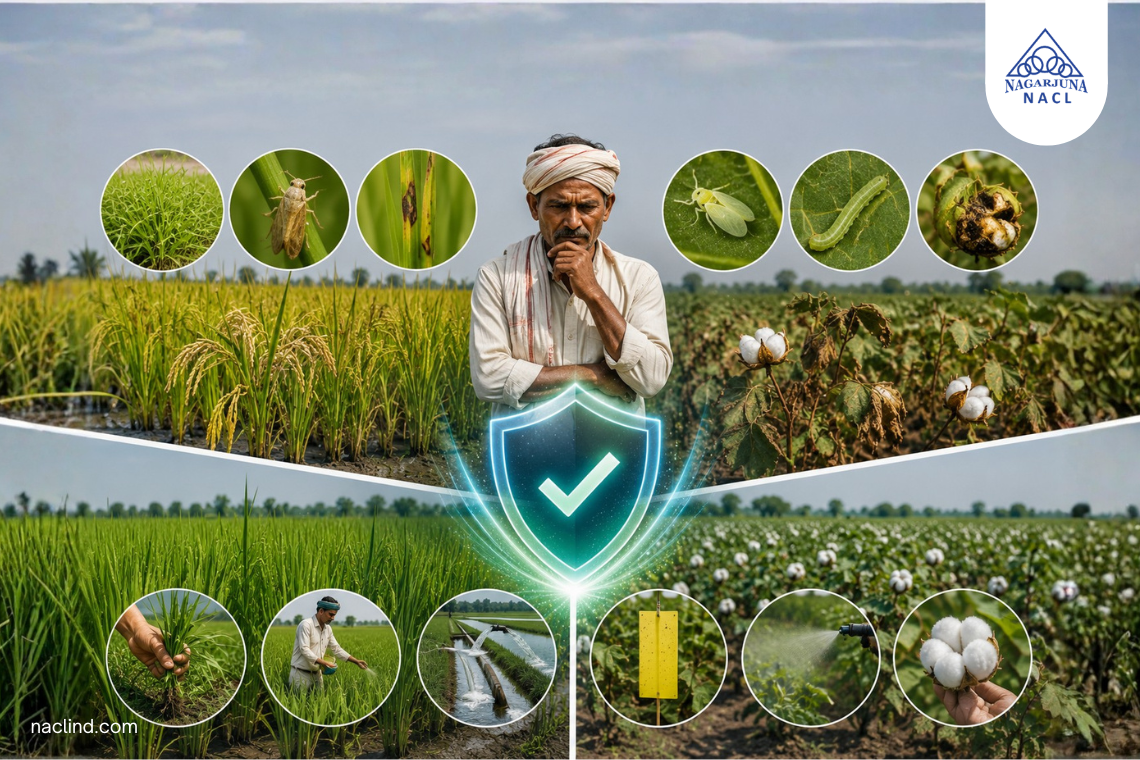
Ask any paddy or cotton farmer in India about the worst part of the growing season, and the answer rarely surprises you. It is not the rain, not the soil, not even the market price. It is the relentless, season-after-season battle against weeds strangling the roots, insects chewing through leaves, and fungal diseases quietly rotting the stem from the inside out. These three forces, working separately or sometimes together, are responsible for crop losses that run into thousands of crores every year across the country.
The good news is that with the right knowledge, the right crop protection solutions, and early action, farmers can defend their fields far more effectively than most currently do. This guide breaks down each threat and, more importantly, what to do about it.
What Are the Most Damaging Weeds in Paddy and Cotton Fields?
In Paddy
The first 30 days after transplanting or direct seeding are critical. During this window, weeds compete aggressively for nutrients, sunlight, and water. Barnyard grass (Echinochloa crus-galli), wild rice, and Cyperus rotundus (purple nutsedge) are the most economically destructive. Left unmanaged, they can reduce paddy yield by 40 to 70 percent depending on infestation density and timing.
In Cotton
Broadleaf weeds such as Parthenium and Digera arvensis, and grasses such as Cynodon dactylon, are the primary offenders in cotton. They not only compete for nutrition but also serve as alternate hosts for certain insects and virus vectors, multiplying the problem beyond just yield loss.
Recommended herbicides
| Herbicide | Type & Crop | Usage / Effectiveness |
|---|---|---|
| Pretilachlor 50% EC | Pre-emergence, Paddy | Effective against grasses and sedges within 3 days of transplanting |
| Bispyribac Sodium 10% SC | Post-emergence, Paddy | Broad-spectrum control of grassy and broadleaf weeds |
| Pendimethalin 30% EC | Pre-emergence, Cotton | Reliable against grasses and some broadleaf weeds |
| Quizalofop-p-ethyl 5% EC | Post-emergence, Cotton | Selective grass killer |
| Oxyfluorfen 23.5% EC | Pre-emergence, Cotton & other crops | Broad-spectrum weed control |
When choosing the best herbicides for farming, always consider weed species present, the crop stage, and soil moisture.
Which Insects and Pests Cause the Most Damage to Paddy and Cotton?
Major Pests in Paddy
Brown Plant Hopper (BPH) is one of the most feared pests in paddy cultivation, capable of causing “hopperburn”, where entire patches of the field turn brown and collapse within days. Stem borers, leaf folders, and gall midges round out the list of major insects that attack paddy at different growth stages, from seedling to grain filling.
Major Pests in Cotton
Cotton is famously a pest magnet. American bollworm (Helicoverpa armigera), pink bollworm, whitefly, thrips, and mealybug are the insects every cotton farmer dreads. Bollworm damage to bolls directly destroys yield; whiteflies are doubly dangerous because they transmit Cotton Leaf Curl Virus (CLCuV), which has no cure once it takes hold.
Recommended Insecticides
| Insecticide | Type / Nature | Target Crop | Usage / Effectiveness |
|---|---|---|---|
| Chlorpyrifos 20% EC | Broad-spectrum | Paddy | Effective on stem borers, BPH, and soil insects |
| Thiamethoxam 25% WG | Systemic | Paddy | Used as seed treatment and foliar spray for BPH & sucking pests |
| Emamectin Benzoate 5% SG | Contact | Cotton | Effective for cotton bollworm management |
| Profenofos 50% EC | Broad-spectrum | Cotton | Controls bollworms and sucking pests |
| Fipronil 5% SC | Systemic / Contact | Paddy | Effective against BPH and leaf folder, works at low doses |
These pesticide products are among the most widely used and trusted actives on Indian farms. Products from top agrochemical companies in India, are formulated to deliver consistent field performance when used correctly.
NACL Industries, for instance, markets well-known formulations like Profex Super, both effective against a range of caterpillar and sucking pests in cotton and other crops. Their insecticide portfolio covers both contact and systemic modes of action, which is important for building resistance management programs.
What Fungal Diseases Should Paddy and Cotton Farmers Watch Out For?
In Paddy
Rice blast (Magnaporthe oryzae) is the most destructive fungal disease in paddy globally, causing up to 50 percent yield loss in severe cases. Sheath blight, caused by Rhizoctonia solani, is equally destructive in humid, high-density plantings. Brown spot and false smut round out the common fungal threats that paddy farmers face every season.
In Cotton
Alternaria leaf spot, grey mildew caused by Ramularia areola, and root rot are the primary fungal concerns in cotton. These diseases spread rapidly in warm, moist conditions and can defoliate plants at critical stages of boll development, significantly reducing final yield and fiber quality.
| Fungicide | Type / Nature | Target Crop | Effectiveness / Usage |
|---|---|---|---|
| Tricyclazole 75% WP | Curative & Preventive | Paddy | Gold standard for rice blast control |
| Hexaconazole 5% SC | Systemic | Paddy | Controls sheath blight and neck blast |
| Propiconazole 25% EC | Broad-spectrum systemic | Paddy & Cotton | Effective against multiple fungal diseases |
| Carbendazim 50% WP | Systemic | Paddy & Cotton | Sheath blight (paddy), root rot & grey mildew (cotton) |
| Mancozeb 75% WP | Protectant | Cotton | Controls Alternaria leaf spot, provides preventive coverage |
| Tebuconazole 25.9% EC | Systemic | Paddy & Cotton | Controls a wide range of fungal diseases |
Selecting the best fungicides for agriculture depends heavily on the disease present, its stage, and environmental conditions. Protectant fungicides like Mancozeb work best as preventive sprays before disease onset; systemic fungicides like Tricyclazole and Hexaconazole penetrate the plant tissue and work curatively when early infection has already begun.
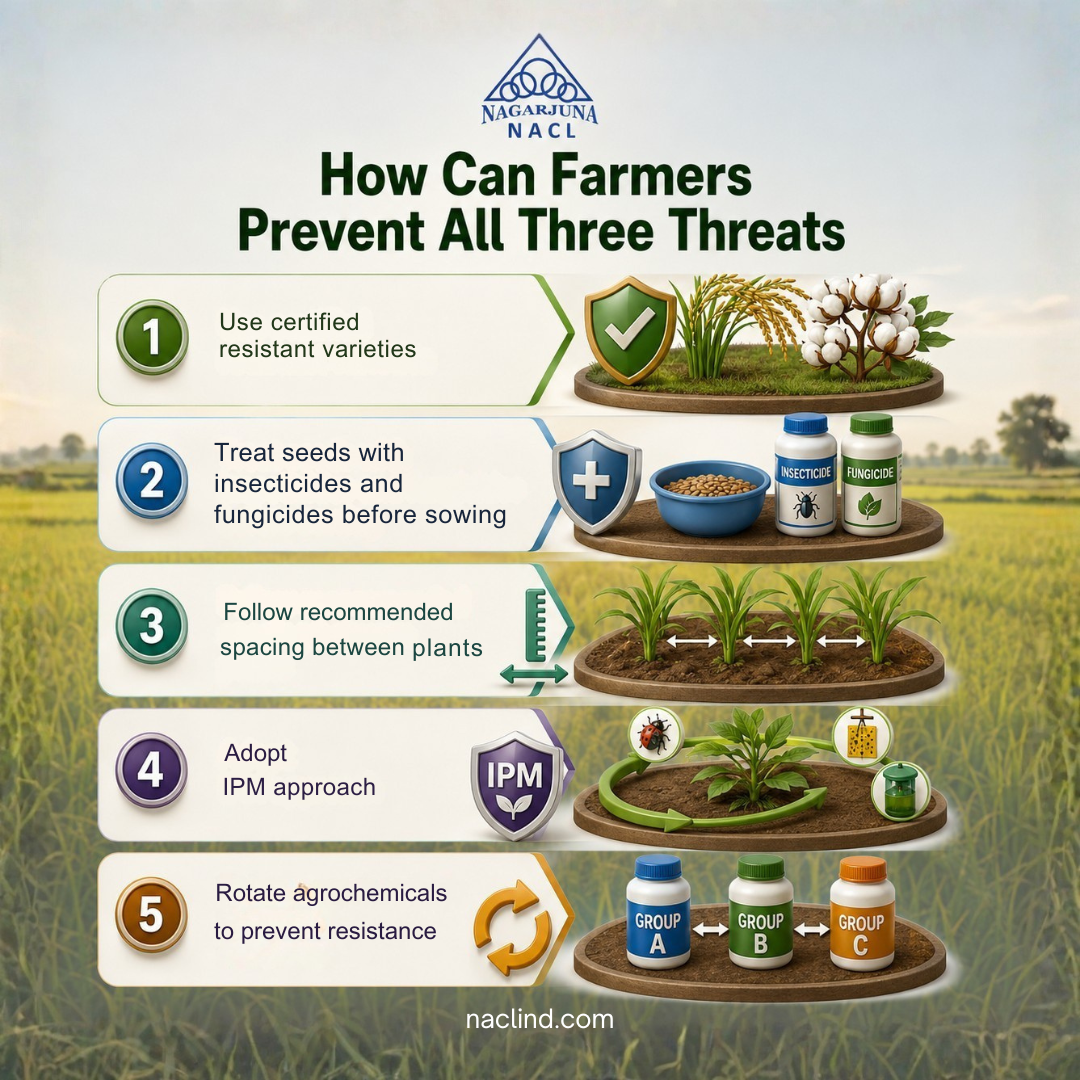
How Can Farmers Prevent All Three Threats Before They Start?
Prevention is not a single action; it is a season-long system. Here is what effective prevention looks like on the ground:
1. Start with Certified, Resistant Varieties
Variety selection is your first and most cost-effective line of defense. Choosing paddy varieties with known blast or BPH resistance significantly reduces pressure on chemical inputs. In cotton, Bt hybrids with verified bollworm resistance are now the standard, but variety of fatigue and secondary pest resurgence mean this is just the starting point, not the solution.
2. Seed Treatment Is Non-Negotiable
Treating seeds before sowing is one of the most underutilized practices in Indian farming. A combination of a fungicide like Carboxin 37.5% + Thiram 37.5% WS and a systemic insecticide like Thiamethoxam 70% WS at the time of sowing protects seedlings during their most vulnerable early weeks, dramatically reducing early-stage pest and disease incidence.
3. Follow the Right Plant Population and Spacing
Overcrowded planting creates microenvironments that favor fungal diseases and block spray penetration. Following recommended spacing for paddy (20 × 15 cm or 25 × 20 cm, depending on variety) and cotton (90 × 60 cm for hybrid cotton) ensures better air circulation, light interception, and more uniform chemical coverage when applications are needed.
4. Adopt an Integrated Pest Management (IPM) Approach
IPM is not about avoiding chemicals; it is about using them smartly, only when needed, at the right dose and at the right time. This means combining biological agents like Trichoderma viride for soil-borne disease suppression, Trichogramma egg parasitoids for bollworm management, and yellow sticky traps for whitefly monitoring, all before reaching for agricultural insecticides.
5. Timely and Correct Herbicide Application for Weed Control
In paddy, applying a pre-emergence herbicide such as Pretilachlor within 3 days of transplanting, followed by a post-emergence application of Bispyribac Sodium at 15–20 days after transplanting, provides nearly complete weed control during the critical early 45-day window. In cotton, shallow inter-cultivation at 20 and 35 DAS, combined with a pre-emergence herbicide such as Pendimethalin, can eliminate the need for manual weeding in most seasons.
6. Monitor, Scout, Record
Farmers who walk their fields twice a week and record what they observe; insect counts, disease symptoms, and weed pressure are always better prepared than those who react to what is visible from the bund. Good scouting data drives better decisions about which pesticide products to apply, when, and at what dose, saving both money and the risk of resistance development.
7. Rotate Chemistries to Prevent Resistance
Spraying the same insecticide or fungicide repeatedly creates selection pressure that accelerates resistance in pest and pathogen populations. Rotate among different modes of action within action groups: for instance, alternate Emamectin Benzoate with Spinosad or Chlorantraniliprole for bollworm management; rotate Tricyclazole with Propiconazole for blast control. This is a cornerstone of sustainable crop protection solutions.
The Bottom Line
Weeds, pests, and diseases will always be part of farming, but their impact can be minimized with the right approach. Instead of reacting to problems, farmers should focus on preventive strategies, timely pesticide application, proper field management, and the use of advanced crop protection solutions.
By combining traditional knowledge with modern agricultural practices and choosing products from the Top Agrochemical Companies in India, farmers can better protect their paddy and cotton crops.
In the end, a healthy crop is not just about higher yield; it’s about sustainability, profitability, and long-term success in farming.
